The Guarijío (Guarijio) People of Southern Sonora, Mexico
The Guarijío people of Sonora, who call themselves Macurawe or Macoragüi – meaning “those who walk the land” – are an Indigenous group whose ancestral territory lies in the Sierra Madre Occidental of southeastern Sonora, extending into the neighboring state of Chihuahua. Their communities stretch from the town of Álamos eastward toward the Chihuahua border, in one of the most remote and culturally rich regions of Sonora.
Location
The traditional lands of the Guarijío border the territory of several other indigenous peoples and municipalities:
- To the west: The Yoreme (Mayo) people in the Álamos–Quiriego region
- To the south: Tarahumara communities in Chihuahua
- To the north: The municipality of Tesopaco
- To the east: The Sonora–Chihuahua border
Today, there are two main Guarijío populations:
- Guarijíos of Sonora – approximately 2,000 people, closely related to the Mayo culture
- Guarijíos of Chihuahua – approximately 3,000 people, more culturally aligned with the Tarahumara (Rarámuri)
History and Formation of Two Sub-Groups
This division traces back to the 1620s, when the Guarijío resisted Jesuit efforts to establish a mission in Chinipas. The Spanish military response led to the dispersal of Guarijío communities, which eventually regrouped on either side of modern-day state borders, forming the two distinct but related populations of today.
In Sonora, Guarijío communities are found in small villages such as Los Bajíos, San Bernardo, Burapaco, Guajaray, Mochibampo, Bavícora, and Mesa Colorada (largest concentration).
Daily Life and Traditional Knowledge
The Guarijío are deeply connected to their mountainous and semi-arid environment. Many families practice subsistence agriculture, cultivating crops such as corn, beans, and squash, which are well adapted to the region’s climate.
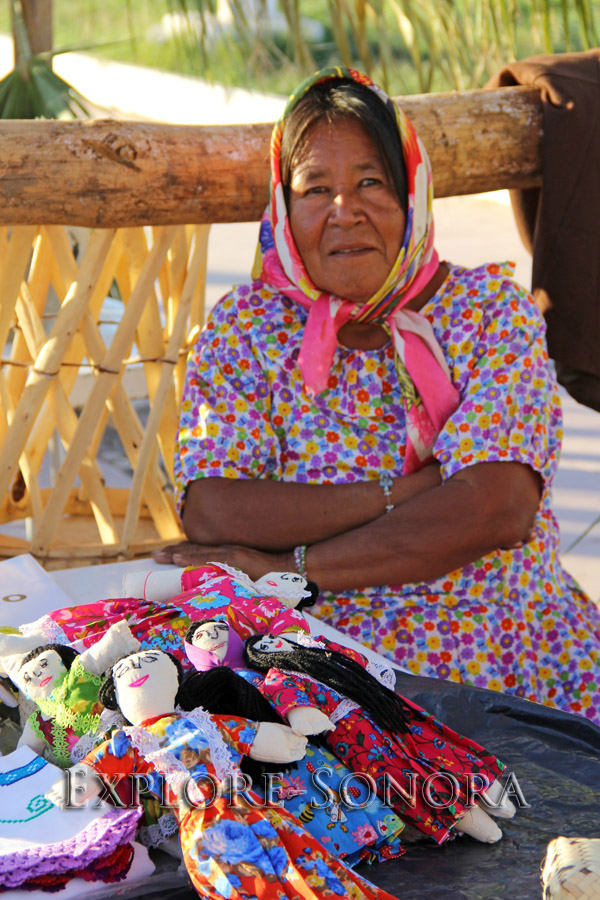
Women are especially known for their traditional crafts, including hand-woven baskets and mats (made from palm and local fibers), clay pottery, and hand-sewn dolls and clothing.
Men commonly create wood carvings and musical instruments, as well as painted figures of local animals.
Religion and Cultural Celebrations
The Guarijío practice a form of Catholicism blended with ancient Indigenous beliefs, mythology, and ritual tradition – a spiritual worldview shared with neighboring Mayo and Tarahumara cultures.
They hold important ceremonial events called tuburadas, the most significant of which are known as Cava-Pizcas. These sacred celebrations involve traditional music and drumming, ritual dance and theater, and prayer and offerings to both ancestral and Christian spiritual forces.
Cava-Pizcas are held to honor:
- The arrival of the rains
- Planting and harvest cycles
- Feast days of saints (especially San Isidro Labrador)
- May 10, in remembrance of José Zazueta, the first Traditional Governor of the Guarijío people
Current Challenges and Resilience
Guarijío communities continue to face significant challenges such as limited access to healthcare and education, geographic isolation, lack of transportation infrastructure, and environmental pressures.
Despite these difficulties, Guarijío culture remains resilient, preserved through language, ceremony, oral tradition, craftsmanship, and a profound connection to their ancestral lands.
Sources
Wikipedia – Guarijios
Asignatura Regional – Etnia: Guarijios
El Imparcial – Guarijios Caminando Bajo la Sombra de Los Pilares