
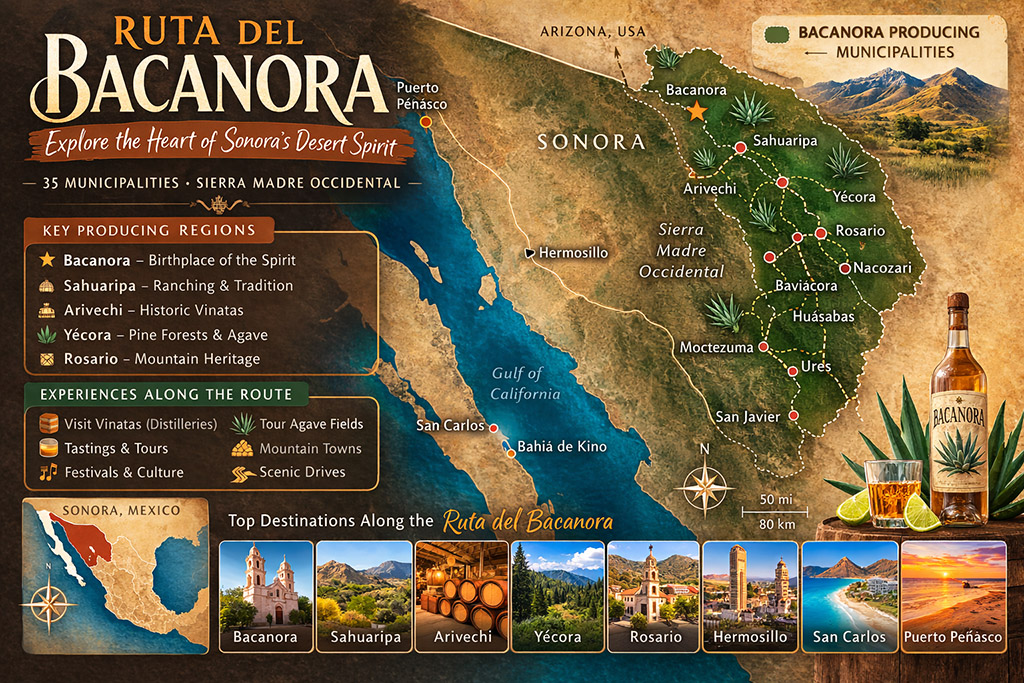
In the mountains and desert valleys of Sonora, a traditional spirit has been produced for generations using the agave plant and methods passed down through families. That spirit is bacanora, one of Mexico’s most distinctive regional beverages.
Often compared to tequila or mezcal, bacanora has its own identity rooted deeply in Sonoran culture, geography, and history.
A Spirit with Deep Sonoran Roots
Bacanora is produced primarily in the mountainous regions of Sonora using Agave angustifolia, commonly known as agave pacífica. The production process involves roasting the agave hearts, fermenting the sugars, and distilling the spirit to produce a clear liquor with earthy and herbal characteristics.
For much of the 20th century, bacanora production was prohibited by law, forcing many families to continue the tradition in secret. Despite the ban, knowledge of bacanora distillation survived in rural communities.
In 1992, the Mexican government officially recognized bacanora as a legal regional spirit. Today it holds a Denomination of Origin, meaning it can only be produced in designated municipalities of Sonora.
A Growing Interest Among Visitors
As travelers seek authentic regional experiences, bacanora has become an important part of Sonora’s cultural and culinary identity.
Visitors to the state often encounter bacanora in local restaurants, tasting experiences, distillery visits, cultural festivals, and regional celebrations.
For many travelers, tasting bacanora is part of discovering the character and traditions of Sonora.
Supporting Local Producers
Bacanora production is typically carried out by small family-owned operations. These producers maintain traditional knowledge while adapting to new markets and tourism opportunities.
As interest grows, many producers are exploring ways to share their products with visitors and customers beyond their local communities.
Clear information about producers, tasting opportunities, and regional traditions helps travelers appreciate bacanora and the culture surrounding it.
Bacanora and the Future of Sonora Tourism
As interest in regional spirits grows worldwide, bacanora has the potential to become an important part of Sonora’s tourism identity.
For visitors, it offers a connection to the land, history, and traditions of the state. For producers, it offers an opportunity to share their craft with new audiences.
